
FAQ’S
The Master of Design in Interior Design is a postgraduate program focused on advanced design thinking, spatial planning, human-centric interiors, and sustainable built environments. It combines creativity, functionality, and technical knowledge.
The course usually spans 2 years (4 semesters) in full-time mode.
Graduates can work as:
- Interior Designers
- Design Consultants
- Furniture Designers
- Lighting Designers
- Space Planners
- Exhibition Designers
- Visual Merchandisers
- Set Designers (film/TV/theatre)
- Sustainable Materials Consultants
Yes. Students interested in research or academia can pursue a Ph.D. in Design, Interior Architecture, or Built Environment Studies.
Yes. Many graduates choose freelancing or start their own studios, often focusing on niche areas like residential interiors, boutique retail, or custom furniture design.
Entry-level salaries range between ₹4–8 LPA, depending on location, skills, and employer. With 3–5 years of experience, it can grow to ₹10–20 LPA or more, especially for freelance or studio heads.
Search any Program or School


More about SoEC
SOEC focuses on the holistic development of students and aims to provide a platform for aspiring students to be future leaders and lifelong learners. The school focuses on providing accessible modern education in engineering and science. Along with this, it also focuses on advancing knowledge through fundamental and applied research and facilitating life-long learning and economic development. The school has proved to be a high-quality education provider in engineering and provides an enriching scholastic environment. Its central aim is to provide innovative and effective ways of knowledge creation, dissemination, and application to facilitate world-class education and cutting-edge research in the field of engineering, thereby contributing to society nationally and globally.
More about Civil Engineering Department
The department's faculty members keep raising the bar by performing high-caliber research, pushing the boundaries of knowledge, and educating students on the most recent technological advancements. Additionally, the faculty provides technical guidance on current engineering issues to numerous government and private sector businesses across the nation.
- Enhancing academics by including the latest technologies to make the students industry-ready. Providing a scholarly and professional environment in the field of engineering. Promote cutting-edge research and innovation for the development of the nation. To create academic-industry linkage for experiential learning and practical exposure.
- To become a center of excellence in skill development and groom the Engineering professional to cope up with the changing global scenario through research and innovation.
More about Mechanical Engineering Department
Collaboration with AutoDesk for “Center of Excellence” in the field of design engineering is a remarkable step towards creating a regular awareness amongst students for competing themselves with the budding engineers all over the world. Meticulous mentorship program helps the students in every sphere of learning and research.
- To provide state-of-the-art infrastructure to students in order to impart quality education in Mechanical Engineering.
- To develop the students for facing intellectual and ethical career challenges after graduation.
- To motivate staff and students for creative thinking, thereby enriching the teaching learning experience and developing the research activity.
We strive for preparing Mechanical Engineering professionals having sound technical knowledge with innovative approach, who are proficient to pursue diverse and flourishing careers in present society.
More about SoHMT
SoHMT utilizes an advanced, industry-oriented pedagogy to prepare competent and creative individuals. Students refine their skills through interactive visits, guest lectures, and workshops conducted by industry experts. DBUU's commitment to quality extends to SoHMT, making it a premier hotel management university in Uttarakhand that focuses on transforming students into industry-ready professionals. The university boasts an impressive track record of placing graduates in prestigious hospitality establishments.
The school features state-of-the-art kitchens equipped with modern appliances, providing students with the opportunity to acquire diverse and unique cooking techniques that will benefit them throughout their careers. SoHMT offers postgraduate, undergraduate, and diploma programs, including Diploma in Food Production, Food and Beverage, Bakery & Confectionary, Bachelor of Hotel Management, B.Sc. Hotel & Hospitality Management (HHM), BBA - Tourism and Event Management, & Masters of Hotel Management.
More about SoAS
Our skilled and professional students will serve in the scientific community through their skills by training and using the understanding gained. The courses offered were Bachelors in Biotechnology, Physics, Chemistry, Mathematics, Zoology, Forestry, Forensic science, Food technology along with Masters courses in Physics, Chemistry, Mathematics, Zoology, Environmental Science, Forensic Science, Industria Chemistry and Microbiology. School also provide Ph.D programs in Zoology, Microbiology, Chemistry, Mathematics, Physics and Environmental science. The school has well-furnished Chemistry, Microbiology, Zoology, Forestry, Food Technology and Botany lab with certified technologies.
The School of Allied Sciences, the best Allied Science College in Uttarakhand also has a knowledgeable Advanced English Communication Skills Lab and English Language Communication Skills Lab with computers for each aspirant. All class-rooms are supplied with State-of-the-Art advanced class facilities and software for better learning and teaching experi-ence.
Dean's Message

Dr. Vinod Kumar
Professor and Dean, SoEC
The faculty supervises projects with undergraduate students using the latest technologies resulting in the completion of highly applied projects in the areas of Artificial Intelligence, Machine Learning, Deep Learning, Cloud Computing, Cyber Security, Internet of Things that has accelerated the process of moving cutting-edge university research. Our research-driven Masters and PhD programs provide many opportunities to the students to conduct pioneering research with knowledgeable faculty.
Witnessing the technological transformations in recent years, the curriculum is designed to train the students with the skills that are in high demand by the industry. We put forth best efforts to prepare students as world class computer professionals by providing rigorous personality development and grooming sessions that led to both extrinsic and intrinsic confidence boosting. We equally accentuate on the development of core human values, mental relief and physical comfort of our students. Sturdy placements records in the reputed industries year after year have led to our big alumni network all over the world.
If you are committed, dedicated to your goals, and interested in Computer Science Education I can assure you it is the right place to be.
Director's Message

Dr. Bhasker Pratap Chaudhary
Director, IQAC, DBUU
The IQAC strives to maintain the highest standards of academic integrity, transparency and accountability at DBUU through robust evaluation mechanisms, stakeholder engagement initiatives and data-informed decision-making processes. Since its inception, the IQAC has become an integral part of the university, working independently to drive continuous improvement.
We value your support and cooperation. Together, we can make the IQAC at DBUU a pioneer in higher education quality in India.
If you are committed, dedicated to your goals, and interested in Computer Science Education I can assure you it is the right place to be.
Dean's Message

Mr. Chandramauli Dhaundiyal
Officiating Dean, SoHMT
As the world evolves and the industry with it, we need to continue to evolve our curricula, in order to maintain that delicate balance between education, industry, and students. Students need to be prepared to meet industry demands. At the same time, our industry needs graduates who can lead and drive innovation and growth. The School of Hotel Management & Tourism is set on raising the bar. We aim to redefine hospitality education. Future graduates will have the option to focus on growth areas, such as food and beverage service, Facility planning, Entrepreneurship development with faculty collaboration, hone in on research and innovation.
I embrace this responsibility and will devote all my time and energy to preparing and educating those who will lead us in the future.
Associate Dean's Message

Mr. Chandramauli Dhaundiyal
Associate Dean, SoHMT
At the School of Hotel Management and Tourism (SOHMT), we're passionate about igniting a spark in our students for the exciting world of hospitality and tourism. We believe in going beyond textbooks, offering a dynamic program that keeps pace with the ever-changing industry.
Our faculty isn't just about theory – they're seasoned professionals who bring real-world experience into the classroom. We create a vibrant environment where you can develop not just your skills, but also your creativity, leadership, and that genuine enthusiasm for exceeding expectations.
Whether your dream is to manage a luxury resort or lead a travel agency, SOHMT provides the foundation for a successful and rewarding career in the ever-expanding world of hospitality and tourism.
Dean's Message

Dr. Manisha Phogat
Dean, SoA
Just think about diving into groundbreaking research alongside experts in cutting-edge labs. We don't just talk about agriculture; we experience it hands-on, with projects, internships, and industry visits to bring your studies to life. Don't worry about being bookworms – we're committed to nurturing well-rounded individuals who can become future leaders, researchers, entrepreneurs, and changemakers.
Whether you're curious about sustainable farming, groundbreaking research, or building your own agri-business, we have a path for you. So, come join us and cultivate your future, together!
Dean's Message

AR. UDYAN AGGARWAL
Dean, SoAPD
Dev Bhoomi Uttarakhand University recognized the increasing demand for architects and planners and initiated the architecture program to produce highly skilled and creative architects for the new era. We ensure a quality education associated with creativity, innovation and multi tasking capabilities along with the overall personality development of the students.
School of Architecture Planning and Design is not just an institute for learning; rather it’s a place for experimenting new ideas and thoughts. I’m sure that our students will serve the society and humanity in a very innovative and sustainable way. I wish all the students a bright future and everlasting happiness.
Dean's Message

Dr. Poonam Singhal
Dean, SoAS
The School has advanced well-equipped laboratory facilities. Therefore, the students will have ample opportunities for exposure to do research. They are encouraged to undertake intra- departmental research projects as well as to apply for internships/visits to other research institutes & industries.
All our faculty members have excellent academic credentials and are trained at reputed national institutions/ universities. We are proud to possess a highly qualified staff that is totally dedicated and is always striving to perceive and resolve students' queries so that the overall personality of the student can be groomed in such a manner that they graduate as industry professionals and entrepreneurs.
I welcome you to be a part of our School striving towards excellence in education and research.
More about SoPR
- Develop and dispense life-saving medications
- Conduct vital research and improve patient outcomes
- Provide medication counseling and education
- Contribute to innovative drug discovery and development
Ready to Make Your Mark? Join the School of Pharmacy and Research(SOPR), and embark on a transformative journey towards a fulfilling and impactful career in the ever-evolving world of pharmacy.
Dean's Message

Prof.(Dr.) Ashwani Kumar
Dean, SoMC
I sincerely hope that you will make the best use of this amazing opportunity to study at Dev Bhoomi Uttarakhand University. I am confident that our outstanding faculty will inspire and motivate you to work hard and to engage in rigorous academic work reflecting a sense of passionate commitment to achieve excellence in management education and research. The curriculum is designed and enriched with industry support and participation. The pedagogy is heavily interactive with a particular orientation helping them in developing their competency according to the need of Industry. We empower our students with knowledge, skills, and vision to meet the challenges and opportunities of a rapidly changing world.
We are here committed to provide a world-class education to a diverse and talented body of students. Here students are given exposure to new ideas, international perspectives, and innovative teaching in an encouraging and open academic environment. Most of our students have been placed in top MNCs and many of them are handling key positions. Our Alumni will be armed with the skills they need to succeed in a diverse set of fields, both in India and abroad.
Dean's Message

MAJ GEN (DR.) O P SONI. VSM
Dean, SoMC
I sincerely hope that you will make the best use of this amazing opportunity to study at Dev Bhoomi Uttarakhand University. I am confident that our outstanding faculty will inspire and motivate you to work hard and to engage in rigorous academic work reflecting a sense of passionate commitment to achieve excellence in management education and research. The curriculum is designed and enriched with industry support and participation. The pedagogy is heavily interactive with a particular orientation helping them in developing their competency according to the need of Industry. We empower our students with knowledge, skills, and vision to meet the challenges and opportunities of a rapidly changing world.
We are here committed to provide a world-class education to a diverse and talented body of students. Here students are given exposure to new ideas, international perspectives, and innovative teaching in an encouraging and open academic environment. Most of our students have been placed in top MNCs and many of them are handling key positions. Our Alumni will be armed with the skills they need to succeed in a diverse set of fields, both in India and abroad.
Dean's Message
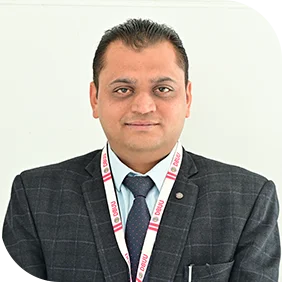
Prof.(Dr.) Tarun Parashar
Officiating Dean
Welcome to, School of Pharmacy & Research at Dev Bhoomi Uttarakhand University Accept my heartiest congratulations for selecting the pharmacy profession as your career. Pharmacy service is a health profession that links health sciences with chemical sciences and aims to ensure the safe and effective use of Pharmaceutical Drugs. The discipline of Pharmacy embraces the knowledge on synthesis, chemistry and preparation of drugs. In line with our vision of providing an 'Problem Based Learning' and research environment designed to develop independent, innovative and creative ideas, the department is offering Diploma course of two years duration under-graduate course of four years duration and post-graduation course of two years duration in Pharmaceutics and Pharmacology streams.
I feel honored to inform you that we started – PhD program also. The Department is enriched with dynamic staff that is known for discipline and dedication, sophisticated computerized laboratories and research facilities to prepare the employable youth as per demand of the Pharma industry & health care system. At the end, I would like to thank you all for taking a shuttle round with us. I cordially invite you to visit our official website and pay a personal visit to our campus.
More about DBUU
The University is committed to its vision of striving to empower students as lifelong learners with critical thinking, leadership, and entrepreneurial skills. Our mission is to set high standards for academics, foster a thriving research environment, and support students to be creative problem-solvers. We aim to instill the spirit of "सिद्धिर्भवति कर्मजा" which means success comes through action.
More about SoA
In addition to a large number of eminent faculty members, SOA is the Agriculture Colleges in Dehradun and has established the best state-of-the-art infrastructure, including well-equipped laboratories, well-maintained practical fields, and much more. We support a distinctive learning environment that ensures students are integrated into the 21st century and supports their overall growth.
More about SoAPD
We see architectural education as a living, breathing link between nature, society, and technology. SoAPD aims to provide students with the most up-to-date technologies as well as innovative and sustainable methods to use them, and it follows an advanced and industry-oriented pedagogy for preparing competent and creative professionals.
More about SoJLA
With over 15+ diverse programs spanning undergraduate, postgraduate, and Ph.D. levels, we cater to a wide range of interests. Delve into the intricacies of journalism, advertising, public relations, filmmaking, digital media, and more. Whether you dream of writing captivating articles, crafting impactful films, or influencing public opinion, we have the program to launch your journey. Our experienced faculty, industry professionals, and state-of-the-art facilities provide a stimulating platform for hands-on learning. Dive into practical workshops, engage in collaborative projects, and gain real-world experience through internships with leading media organizations.
Our graduates enter the workforce equipped with critical thinking skills, creative problem-solving abilities, and strong communication foundations. They thrive in diverse fields such as journalism, advertising, public relations, filmmaking, content creation, and beyond.
Join our vibrant community of learners in the best Mass Communication College in Dehradun and explore the path of a transformative journey at the School of Journalism and Liberal Arts. Discover your voice, refine your skills, and make your mark on the ever-evolving world of communication.
Dean's Message

Prof. (Dr.) Bhawana Goel
Dean I/C, SoJLA
The School of Journalism & Liberals Arts is setting the benchmark in media literacy, media research and is committed to building strong media opportunities for new aspirants who are willing to make a career in the media industry. Dev Bhoomi Uttarakhand University is dedicated to creating a dynamic teaching and research atmosphere in the domain of media studies and liberal arts. The school is making its strongest visibility on the map of India as a center of excellence with continuous assessments. In the past few years, we are able to design industry-oriented media literacy for better career prospects of our young media aspirants. We believe in the training of students with industry interface, inviting industry professionals and celebrities across the country.
The school has advanced laboratory facilities equipped with the state-of-the-art equipment required for the project work & experience. Therefore, the students will have ample opportunities for practical and live exposure. The school is dedicated to encouraging various research projects, internships, and visits. All our faculty members have excellent academic credentials and are trained at reputed national/institutes/universities. We are always striving to perceive and resolve students' queries so that the overall personality of the students can be groomed in such a manner that they graduate as industrial professionals. Thank you for your interest in the school of Journalism & Liberal Arts. I welcome you to be a part of our School striving towards excellence in education and research.
More about SoN
Beyond the classroom, you'll get real-world experience by working directly with patients in top healthcare facilities. These hands-on training sessions help you improve your skills, grow your confidence, develop compassion, and build confidence under the guidance of experienced professionals.
Nursing graduates have many career opportunities and are in high demand. You could work in hospitals, community clinics, public health settings, or even pursue specializations in areas like critical care, pediatrics, or mental health nursing.
As a graduate of our B.Sc. Nursing and GNM diploma programs, you will become part of a distinguished network of alumni who are transforming lives across the country. At the Best Nursing Colleges in Dehradun, we prepare you not just to deliver exceptional care but also to advocate for patients, promote health awareness, and contribute to positive change within the healthcare system. Your journey with us will empower you to make a lasting impact wherever you go.
Dean's Message

Prof.(Dr.) MEHVISH KHALID
Dean, School Of Nursing
The institution has well-qualified competent and skilled faculty members, good physical infrastructure, libraries& labs are equipped with advanced simulators and most importantly, students get opportunities for clinical learning in affiliated teaching hospitals.
The School of Nursing has attained a distinguished reputation in the field of sports and cultural activities. The sports infrastructure within the campus has delivered in powerful ways, and together with academic excellence and a ragging-free environment, has nurtured a rare platform for the betterment of the students.
I warmly invite you to be a proud and all-rounder nursing student of the School of Nursing DBUU.
Dean's Profile

Prof. (Dr.) Suman Vashist
Dean/Principal at School of
Nursing (DBUU)
M.Sc., PHD (N) Mental Health Nursing.
- She is having a Professional experience of 16 years.
- Research Profile- Research gate, Google scholar, ORCID, Academia, Linkedln.
- Being a Life membership of many professional organization TNAI, GFNPSS Executive Membership, NSS LIFE Membership, ISPN life Membership, NTAI, American and New Zealand mental health well being association.
- Many Paper Presentation and Poster Presentation in International conference.
- She is Editor and Reviewer in many journals. She is also published about 45 Researches Article with citation and Patents on different Projects in National and International journals. She is awarded for Project.
- Reviewed of Psychology and Psychiatric text books under the different book publishers.
- She is published books in Nursing Foundation volume- 1 or 11 and psychiatric Nursing log book semester-IV and many Book chapter in IIP proceeding.
- She is an external examiner and PHD guide, thesis evaluators at various universities.
- She also organizes various workshops/seminar and webinar National and International, outreach activities and international Conference related to Nursing topics.
- She have received Book award for Nursing Foundation and Dr. APG Abdul Kalam Bhartiya Ratan Samman Award.
Dean's Message

Dr. Charu Thakur
Dean, DBMCPS
Welcome to Dev Bhoomi School of Allied Health Sciences! We are honored to have you join our esteemed institution, dedicated to educating compassionate and skilled healthcare professionals.
We believe true education empowers individuals to serve. Our dedicated faculty will guide you beyond textbooks and classrooms, fostering both knowledge and strong moral character. You'll be encouraged to actively learn, pursue your passion, and develop the ethical values needed to excel in the paramedical field and make a positive impact on society.
As you embark on this journey, remember that you join a diverse and supportive community. Embrace inclusivity, forge meaningful connections, and support one another. May your time here be transformative, empowering you to flourish as exceptional healthcare professionals, ready to serve humanity.
Dean's Message

Prof.(Dr.) Anil Kumar Dixit
Dean, SoL
Welcome to the Dev Bhoomi family, future lawyers! We are a close-knit community at DBUU, dedicated to fostering your growth into the best legal professionals. Our unique blend of a rigorous academic program and hands-on experiences, designed to prepare you for real-world challenges, sets us apart and will equip you with the confidence to excel in your future career.
You will have the chance to learn from some of the brightest minds in the legal field and network with top professionals. We are deeply committed to developing your courtroom advocacy, legal writing, and research skills, providing you with the support and guidance you need to succeed.
Beyond the classroom, we encourage you to explore your passions through extracurricular activities like moot courts, sports, and community service. We aim to help you become well-rounded and ready for any challenge.
We are thrilled and eagerly anticipate the heights you will reach here at DBUU. Your journey to becoming a successful lawyer begins now, and we are inspired by the potential of what you will accomplish!
More about CE Department
Enhancing academics by including the latest technologies to make the students industry-ready. Providing a scholarly and professional environment in the field of engineering. Promote cutting-edge research and innovation for the development of the nation. To create academic-industry linkage for experiential learning and practical exposure.
To become a center of excellence in skill development and groom the Engineering professional to cope up with the changing global scenario through research and innovation.
More about CE Department
- In addition to the well-prepared curriculum related laboratories, the Department has many state of the art facilities for assisting different projects and development in the embedded system, VLSI, RF Engineering, and wireless technology.
Enhancing academics by including the latest technologies to make the students industry-ready. Providing a scholarly and professional environment in the field of engineering. Promote cutting-edge research and innovation for the development of the nation. To create academic-industry linkage for experiential learning and practical exposure.
To become a center of excellence in skill development and groom the Engineering professional to cope up with the changing global scenario through research and innovation.
Search within the website:
More about B.Tech CSE Programme
The industry-relevant curriculum of btech computer science course provides students with the knowledge of the database, networking, software testing, programming language, operating system, frontend software development, backend software development, network design, network management, database administrator, data analytics, software testing, and maintenance, and system software development, etc.
To give due importance to applied and theoretical aspects of computing, DBUU, one of the best Computer Science colleges in Dehradun makes sure that it also covers most of the foundational features of computing sciences and amplifies the engineering skills among students for problem-solving and innovations using computing sciences.